Spring Climate Course Offerings from Across the University

This spring, Penn faculty and researchers are offering courses that examine climate change through many perspectives, including anthropology, history, and urban planning. These courses invite students to explore how communities around the world grapple with environmental challenges, how scientific knowledge shapes our understanding of climate futures, and the available tools for preserving land and resources. Students will gain critical perspectives on socio-ecological conflicts, land conservation strategies, and the numerous ways people respond to environmental change.slot gacor
These courses represent a small selection of the many climate-related classes available on our campus, showcasing the wide range of expertise that Penn brings to environmental education. We encourage students to explore climate-related offerings by browsing Penn’s course catalog, where they’ll find many more opportunities to engage with climate challenges and solutions in the classroom.
ANTH/URBS 2970: Nature Culture Environmentalism
Instructor: Sita Mamidipudi
Course description: Water wars, deforestation, climate change. Amidst many uncertain crises, in this course we will explore the emergent relationship between people and the environment in different parts of the world. How do people access the resources they need to live? How, when and for whom does ‘nature’ come to matter? Why does it matter? And what analytical tools we might use to think, mitigate and adapt to the effects of climate change? Drawing together classical anthropological texts and some of the emergent debates in the field of climate studies and environmental justice, in this class we focus on the social-ecological processes through which different groups of humans imagine, produce and inhabit anthropogenic environments.

Sita Mamidipudi is a Climate Postdoctoral Research Fellow at the Center for the Advanced Study of India and an environmental anthropologist whose research examines climate precarities, environmental dispossession, and property relations in India. At Penn, Mamidipudi is furthering her dissertation research, while also contributing to Nikhil Anand’s project “Stories of Climate Action: Negotiating Planning in Mumbai’s Wetscapes.” She holds a PhD in Anthropology from UCLA and has worked extensively as an educator and researcher at institutions in India and UCLA.
STSC 1880 Environment and Society
Instructor: Melissa Charenko
Course description: This course examines contemporary environmental issues such as energy, waste, pollution, health, population, biodiversity and climate through a historical and critical lens. All of these issues have important material, natural and technical aspects; they are also inextricably entangled with human history and culture. To understand the nature of this entanglement, the course will introduce key concepts and theoretical frameworks from science and technology studies and the environmental humanities and social sciences. Note: Students who register for this course must also register for a recitation section.

Melissa Charenko is an Assistant Professor in the Department of History and Sociology of Science at Penn and a historian whose research examines paleo-disciplines, fields that reconstruct past environments through proxies such as pollen, and their role in shaping our understanding of anthropogenic environmental change. At Penn, Charenko explores how scientific reconstructions of past climates inform notions of deep time and environmental futures, bridging history, science, and environmental studies to address today’s climate crisis. She holds a PhD in History of Science from the University of Wisconsin-Madison.
ANTH 3750/5750: Latin American Environmentalisms: Ecological Conflict and Cuidado (Care) across the Americas
Instructor: Kristina Lyons
Course description: This course thinks with and from Latin America to consider the environmental and ecological conflicts and politics of cuidado (care) emerging across the hemisphere in times of climate crisis and deepening socio-environmental injustice. Latin American thinkers and practitioners have provided innovative conceptual and methodological tools for analyzing, organizing, and acting in defense of territory and life. In this course, we will consider how legacies of colonialism and (neo)extractivism are not only an ongoing curse of the Americas, but also a condition of possibility for feminist, decolonial, Indigenous, and ecological proposals, such as degrowth, buen vivir, cuerpo-territorio (body-territory), rights of nature, ontological politics, and participatory action research, among other ways of knowing, being, and doing. What can we learn from engagement with the historic and contemporary socioenvironmental challenges occurring across the Spanish and Portuguese-speaking Americas? How are diverse urban and rural communities, technoscientific actors, researchers, and ancestral knowers understanding and responding to the region’s emerging climate and environmental scenarios? What are the possibilities for dialogue, exchange, and problem solving between such diverse actors and their multiple ways of knowing and being that span millennial, colonial, and modernizing temporalities? Throughout the course, we will interrogate and reflect on these questions from the situated perspectives of Latin America and its many territorial realities, ecological relations, and social worlds.
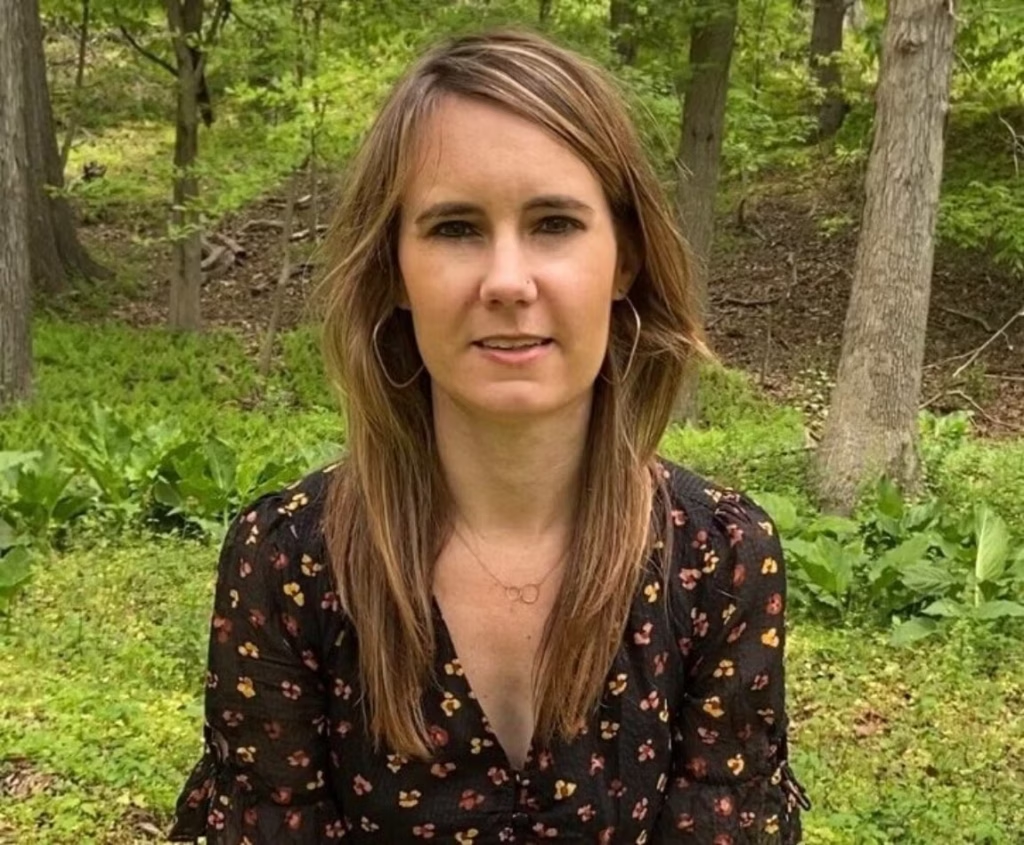
Kristina Lyons is an Associate Professor of Anthropology in the School of Arts and Sciences and the Penn Program in Environmental Humanities at the University of Pennsylvania. Her research explores socio-ecological conflicts, science studies, and legal questions across Latin America. In her book Vital Decomposition: Soil Practitioners and Life Politics (Duke 2020), Lyons weaves together the work of state soil scientists and small farmers in Colombia as they seek alternatives to commercial coca crops and the military-led development models designed to replace them. She holds a PhD in Anthropology from the University of California, Davis.
CPLN 6310: Planning for Land Conservation
Instructor: Tom Daniels
Course description: Land preservation is one of the most powerful, yet least understood planning tools for managing growth and protecting the environment. This course provides an introduction to the tools and methods for preserving private lands by government agencies and private non-profit organizations (e.g., land trusts). Topics include purchase and donation of development rights (also known as conservation easements), transfer of development rights, land acquisition, limited development, and the preservation of urban greenways, trails, and parks. Preservation examples analyzed: open space and scenic areas, farmland, forestland, battlefields, and natural areas. Note: Enrollment is limited to Graduate/Research, Law, or Professional level students.

Tom Daniels is a Professor in the Department of City and Regional Planning at Penn, where he directs the concentration in Land Use and Environmental Planning. His work focuses on farmland preservation, land use planning, and environmental conservation. From 1989 to 1998, Daniels managed the nationally recognized farmland preservation program in Lancaster County, Pennsylvania, where he lives. Daniels is well-known as one of the leading thinkers and practitioners of farmland preservation and co-authored works including Holding Our Ground: Protecting America’s Farms and Farmland (Island Press, 1997) and The Law of Agricultural Land Preservation in the United States (American Bar Association, 2018). He holds a PhD in Agricultural Economics from Oregon State University.
